
Dr. K. H. S. M.Sampath
November 8, 2026
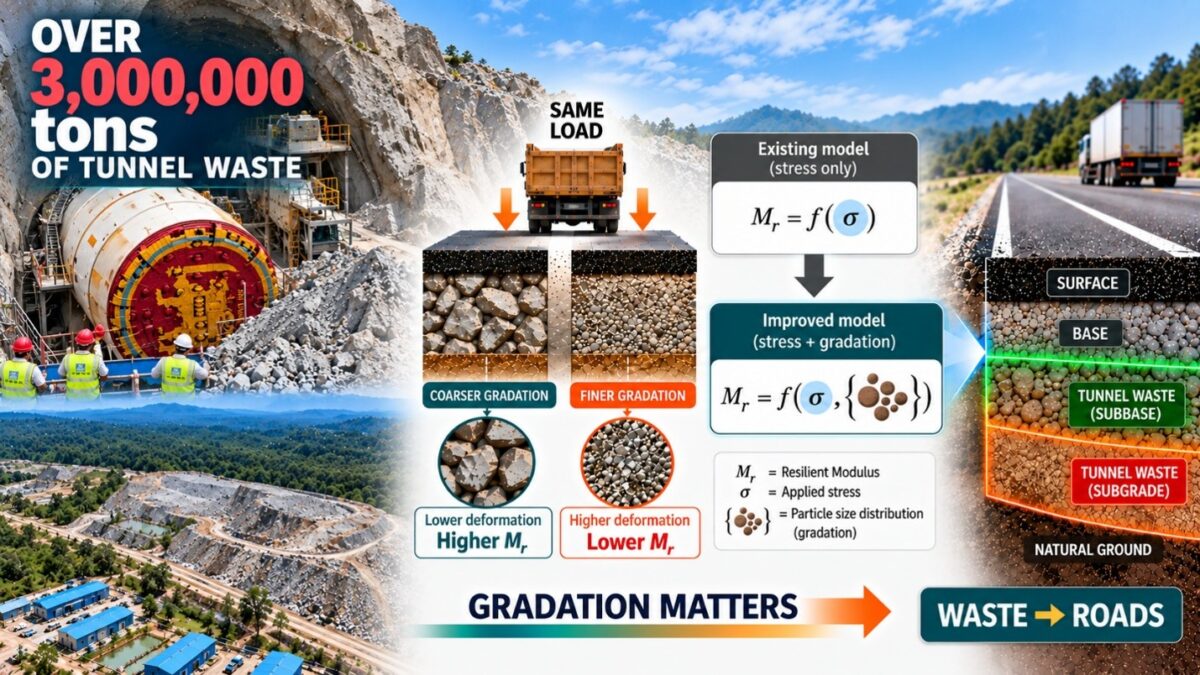
Effect of Particle Size Distribution on the Resilient Modulus of Tunnelling Rock Waste for Pavement Applications
November 8, 2026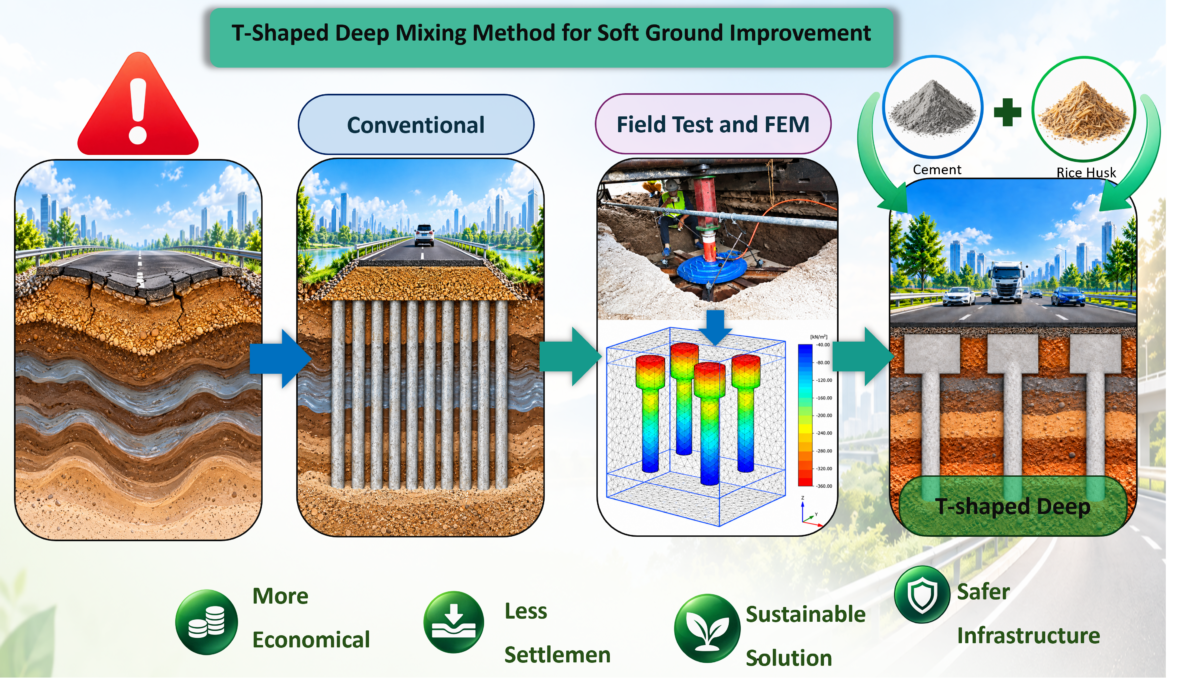
Research Area: Ground Improvement | Sustainable Geotechnical Engineering
The increasing demand for land development has led to the utilization of soft ground for infrastructure and building construction. However, the low bearing capacity and high compressibility of soft soils, particularly peaty clay, present significant geotechnical challenges. Conventional Deep Mixing (DM) techniques often require closely spaced columns, resulting in increased binder consumption, construction costs, and potential environmental impacts.
This research investigates the T-shaped Deep Mixing (TDM) method as an improved ground stabilization technique, incorporating an enlarged shallow column head to enhance load transfer and minimize settlement. A sustainable binder comprising cement and rice husk ash (RHA) was utilized to reduce reliance on conventional cement-based stabilization.
The study involved laboratory-scale model testing, finite element modelling at laboratory and field scales, parametric investigations of column geometry, and a preliminary cost comparison with conventional DM columns. The influence of key geometric parameters, including cap diameter, column diameter, cap height, and area replacement ratio, was evaluated to identify optimal configurations.
The experimental findings demonstrated that TDM columns reduced settlement by approximately 92% compared with untreated peaty clay and 70–80% compared with conventional DM-treated ground under different loading conditions. Numerical investigations further confirmed the superior settlement reduction performance of the TDM configuration. The parametric analysis identified suitable geometric proportions, with a cap-to-column diameter ratio (D1/D2) of up to approximately 1.7 and a cap-height-to-total-column-height ratio (L1/L) between 0.125 and 0.25. Furthermore, the preliminary cost assessment indicated a potential 57% reduction in treatment cost compared with conventional DM columns.
Overall, this research demonstrates the potential of cement–RHA-based TDM columns as a sustainable and cost-effective solution for improving soft ground, particularly peaty clay, while achieving enhanced settlement control and more efficient binder utilization.