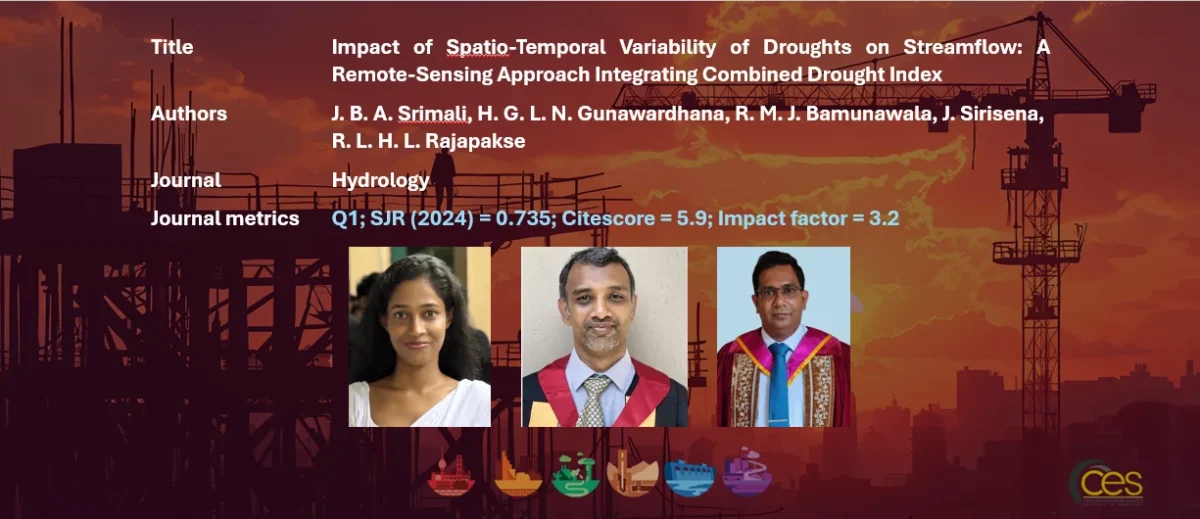

Q1 publication in Hydrology
June 6, 2026
Materials Today Communications
June 6, 2026
Carbon fibre woven composites have emerged as engineered materials for lightweight, tailorable and high-performance applications. Predicting their macroscale mechanical properties remains a challenge due to uncertainties in their microscale and mesoscale configurations. This study presents an integrated framework using multiscale modelling and explainable machine learning to address these complexities. A representative unit cell approach was employed to capture the influence of fibre architecture, ply arrangement, and constituent properties, which were validated using experimental data. Among the machine learning models tested, extreme gradient boosting achieved superior predictive accuracy with and normalised root mean squared error values below 0.05 for all ABD stiffness matrix entries. Shapley additive explanations quantified the impact of material and geometric parameters, revealing that ply number, tow thickness, and fibre volume fraction are dominant factors. Uniquely, this study utilised Shapley values and the extreme gradient boosting model to derive new analytical equations for ABD stiffness entry predictions, marking a novel application in composite material science. These equations, validated with previously unseen experimental data, enable rapid and precise stiffness predictions. Further, this developed framework can be used as an efficient complementary tool for analysis and design optimisation of carbon fibre woven composites.