Journal of Composite Structures (Q1) – Undergraduate research
June 6, 2026
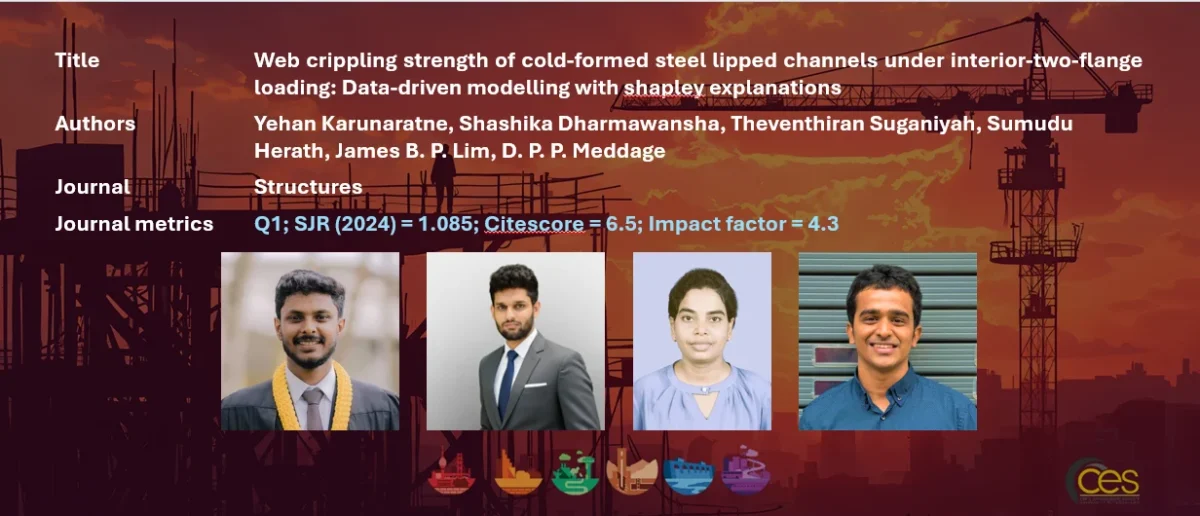
Web crippling strength of cold-formed steel lipped channels under interior-two-flange loading
June 6, 2026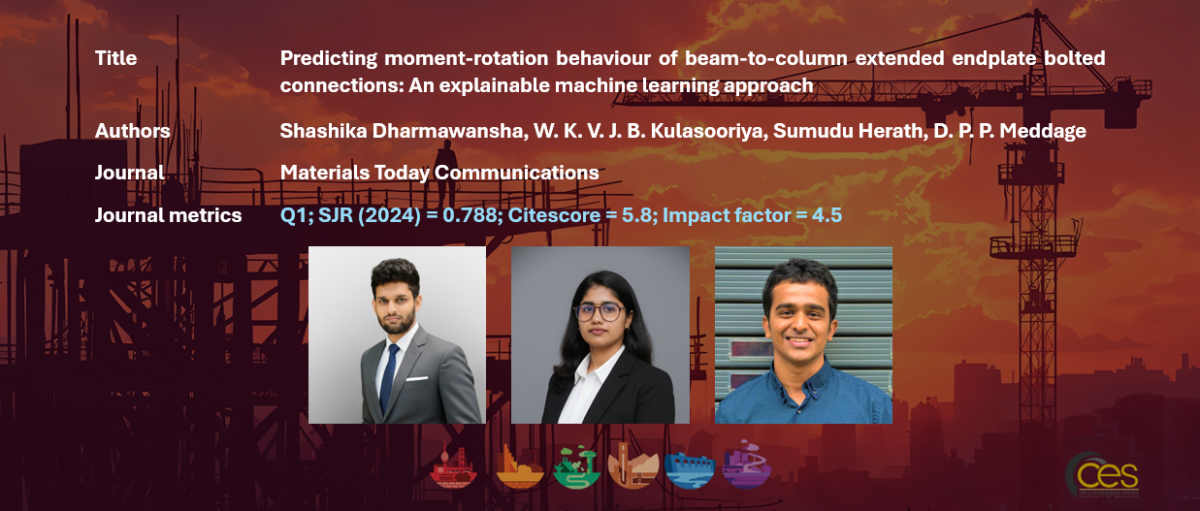
Machine learning has been used to model the moment-rotation behaviour of steel extended endplate connections based on geometric parameters. However, these black-box models lack interpretability. This study employs an explainable machine learning approach to predict the moment-rotation response of steel extended endplate bolted connections. A comprehensive numerical modelling approach was utilised to generate data for varying input features such as endplate thickness, bolt diameter, overall section width, overall depth, web thickness, flange thickness, vertical bolt spacing, and horizontal bolt spacing. An Artificial Neural Network (ANN), Extreme Gradient Boost (XGB), Random Forest (RF), and K-Nearest Neighbours (KNN) were employed alongside Shapley Additive Explanations (SHAP) and Local Interpretable Model Agnostic Explanations (LIME) to interpret the trained models. The comparison reveals that the XGB model achieved the best accuracy, with a training R² of 0.999 and a testing R² of 0.998. SHAP explanations adhere to what is generally accepted in the behaviour of steel extended endplate bolted connections as per EN 1993–1–8. The developed SHAP-embedded graphical user interface (GUI) predicts the moment–rotation curve and visualises the contribution of each parameter to the response. While the GUI generates results in around 10 s, numerical analysis required an average of 40 min on a computer with an Intel® Core™ i5–8250U CPU @ 1.60 GHz.